Di suatu pagi, matahari menyapa dengan hangatnya. Sebelum siang nanti ia mengambil alih dengan terik yang membakar, sebuah rutinitas cuaca yang makin terasa tidak menentu di tengah laju pemanasan global. Se-tidak menentunya gerakan perekonomian dan politik global saat ini.
Namun, ada yang berbeda dari cara saya menatap pagi ini. Sudut pandang dan pola pikir saya terasa jauh lebih jernih dalam memaknai keadaan. Perubahan ini lahir dari kelapangan pikiran dan nilai “berserah diri” yang belakangan ini saya dalami.
Ketika kita melepaskan ilusi kendali dan mengadopsi nilai tanpa batas yang membebaskan, dunia yang sebelumnya kerapkali tampak sebagai ancaman tiba-tiba menjelma menjadi sesuatu yang lebih manis di pelupuk mata.
Jaring Paranet
Belum lama berselang, teras rumah kami yang biasanya terbuka atapnya, kini dipasangi jaring pelindung berwarna hitam. Jaring itu bernama paranet (shading net). Jaring yang dirancang khusus untuk memecah intensitas terik UV matahari siang tanpa menghalangi sinar esensial yang dibutuhkan kehidupan di bawahnya. (sebelum menulis ini saya lupa nama jaringnya disebut apa, dan menanyakan ke Ayah saya, dan bertanya ke Google untuk lebih detail kegunaannya).
Di bawah naungan paranet baru itulah, saya menemukan sebuah pemandangan menarik pagi itu. Tanaman-tanaman yang biasanya tumbuh sedikit berantakan, kini tampak tegak, mencari celah sinar layaknya Superman yang sedang menyerap energi dari matahari.
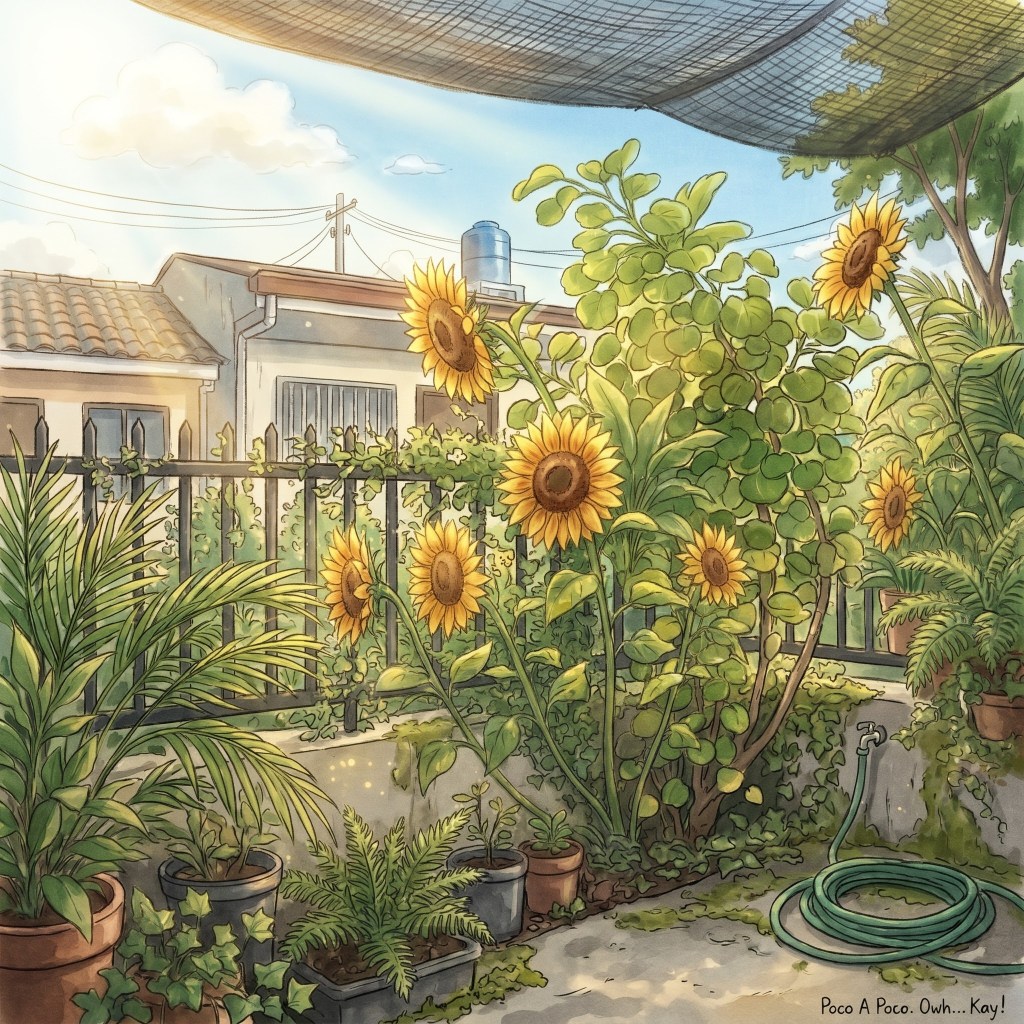
Sekilas, jika saya tidak salah ingat di semalam sebelumnya, Ayah saya juga baru saja memangkas dan merapikan tanaman-tanaman tersebut. Ayah saya memang dikenal memiliki green thumb atau “tangan dingin”, bakat yang entah mengapa tidak menurun ke saya, sebuah sentuhan yang selalu berhasil menumbuhkan apapun yang ia tanam.
Pemangkasan atau pruning (istilah yang saya temukan ketika mencari tahu apa itu paranet) dilakukan Ayah saya semalam bukanlah sekadar merapikan daun. Entah ia melakukannya dengan kesadaran penuh atau tidak, secara botani, memotong ujung dahan akan mematahkan dominansi apikal, kondisi di mana hormon pertumbuhan berkumpul hanya di pucuk atas. Ketika pucuk itu dipotong, hormon menyebar ke seluruh cabang samping, memaksa tanaman tumbuh lebih rimbun dan tegak di keesokan harinya. Mungkin kita bisa analogikan dalam proses pemulihan kita, kita memang harus “dipangkas” dari kebiasaan lama agar bisa bertumbuh lebih kuat dari berbagai sisi.
Fototropisme
Melihat dedaunan itu bergerak miring mencari celah cahaya dan sinar matahari, menyadarkan saya pada satu hal: ke mana pun kita tumbuh, seyogianya kita akan selalu memiliki insting untuk mencari cahaya kebaikan yang menumbuhkan diri.
Secara ilmiah, pergerakan mencari cahaya ini disebut Fototropisme (lagi, sebuah istilah baru yang saya pelajari ketika menjelajah dunia maya mencari tahu apa itu paranet).
Tumbuhan memiliki sensor yang merespons sinar. Ketika cahaya datang dari satu arah, hormon auksin akan secara otomatis berpindah ke sisi batang yang gelap. Penumpukan hormon di sisi gelap inilah yang membuat sisi tersebut tumbuh lebih panjang, sehingga memaksa batang membungkuk ke arah cahaya. Gerakan ini yang disebut Fototropisme tadi.
Tumbuhan tidak pernah marah pada sisi gelapsnya; mereka menggunakan sisi gelap tersebut untuk mendorong diri mereka menuju tempat yang terang.
Manusia pun semestinya demikian. Di tengah masa-masa paling kelam, kita akan selalu mencari celah terang. Kutipan dari Jalaluddin Rumi, atau yang biasa dikenal Rumi di jagat sosial, merangkum hal ini dengan indah:
“The wound is the place where the Light enters you.” (Luka adalah tempat di mana cahaya memasukimu).
Melalui luka, Semesta selalu menyelipkan cahayanya ke dalam ruang-ruang kehidupan kita. Andai saja kita selalu jeli melihatnya. Andai saja kita tidak membiarkan diri dijajah oleh kemarahan atas keadaan hari ini, terbebas dari kebencian akan masa lalu, dan memegang teguh keyakinan bahwa semua akan baik-baik saja di masa depan. But let’s move on. “Andai saja…” tidak akan membawa kita kemanapun jika kita tidak bergerak.
Bunga Matahari
Jika diibaratkan kita sebagai Bunga Matahari. Secara sains, bunga matahari memiliki kemampuan pergerakan unik yang disebut Heliotropisme. Sesungguhnya, istilah ini bukanlah sebuah istilah asing bagi kita. Jika kita ingat-ingat kembali, ketika duduk di bangku sekolah dasar, kita sudah mengenal Heliotropisme dan Bunga Matahari sebagai salah satu objek untuk diobservasi sebagai tugas sekolah dulu. Tapi mungkin kita bisa mendalaminya lebih jauh saat ini.
Bunga Matahari tidak hanya bergerak mengikuti kemana matahari itu berpindah. Mereka juga mengandalkan tekanan air dan kalium di dalam batangnya untuk secara aktif memutar “wajah” mereka mengikuti pergerakan matahari dari timur ke barat setiap harinya. Now I know why.
Mungkin filosofi inilah yang menjadi nafas dari simbol bunga matahari (Sunflower) atau aplikasi pemulihan yang sering kita temukan. Tersadar dari pengalaman melihat dedaunan di teras pagi ini, pesannya sangat jelas:
Sesulit apa pun hari ini, selalu arahkan diri kita ke arah cahaya.
Teruslah bertumbuh. Pelan-pelan saja. Poco a poco. And we’re definitely going to be Owh… Kay!
One morning, the sun greeted with its comforting warmth before taking over later in the day with its scorching heat—a weather cycle feeling increasingly erratic amid global warming, just as unpredictable as the current global economic and political currents.
Yet, there was something tangibly different in how I looked at this morning. My perspective and mindset felt far clearer in finding meaning in my circumstances. This shift was born from a newfound spaciousness of mind and the profound value of “surrender” that I have been deeply embracing lately.
When we release the illusion of control and adopt liberating, limitless values, the world that previously seemed like a constant threat suddenly transforms into something much sweeter before our eyes.
The Shading Net
Not too long ago, our house’s terrace, which usually had an open roof, was fitted with a black protective net. It is called a paranet (shading net). It is a net specifically designed to break the intense UV rays of the midday sun without blocking the essential light needed by the life beneath it. (Before writing this, I forgot what the net was called, asked my father, and checked Google for more details on its utility).
Beneath the shelter of that new shading net, I discovered a fascinating sight that morning. The plants that usually grew a bit haphazardly now stood upright, seeking slivers of light like Superman absorbing energy from the sun.
Come to think of it, if I remember correctly from the night before, my father had also just pruned and tidied up those plants. My father is indeed known for having a green thumb or “tangan dingin”—a talent that somehow wasn’t passed down to me—a touch that always manages to grow whatever he plants.
The pruning (a term I stumbled upon while researching the shading net) my father did last night was not merely about tidying leaves. Whether he did it with full awareness or not, botanically speaking, snipping the tips of branches breaks apical dominance—a condition where growth hormones concentrate solely at the top shoots. When that tip is cut, the hormones disperse to all the lateral branches, forcing the plant to grow bushier and stand taller the very next day. Perhaps we can draw an analogy to our own recovery process: we truly must be “pruned” from our old habits to grow stronger from all sides.
Phototropism
Watching those leaves tilt to seek the cracks of sunlight made me realize one profound thing: wherever we grow, we should inherently always possess the instinct to seek the light of goodness that nurtures us.
Scientifically, this movement toward light is called Phototropism (again, a new term I learned while surfing the web to understand shading nets). Plants possess sensors that respond to light. When light comes from one direction, the auxin hormone automatically relocates to the darker side of the stem. The accumulation of hormones on this dark side is exactly what makes that side grow longer, effectively forcing the stem to bend toward the light. This movement is what we call Phototropism.
Plants are never angry at their dark side; they use that very darkness to push themselves toward the light.
We, as humans, should be the exact same way. In the midst of our darkest times, we will always search for a sliver of light. A quote by Jalaluddin Rumi, or simply known as Rumi across the social sphere, encapsulates this beautifully:
“The wound is the place where the Light enters you.”
Through our wounds, the Universe always slips its light into the spaces of our lives. If only we were always observant enough to see it. If only we did not let ourselves be colonized by anger over today’s circumstances, broke free from hatred of the past, and held firmly to the unwavering faith that everything will be alright in the future. But let’s move on. “If only…” will never take us anywhere if we do not actively move.
Sunflowers
Imagine if we were Sunflowers. Scientifically, sunflowers possess a unique movement ability called Heliotropism. Truthfully, this isn’t a foreign term to us. If we recall our elementary school days, we were already introduced to Heliotropism and Sunflowers as subjects of observation for school assignments. But perhaps we can dive deeper into it now.
Sunflowers do not merely move to follow where the sun shifts. They actively rely on water pressure and potassium inside their stems to turn their “faces,” tracking the sun’s trajectory from east to west every single day. Now I know why.
Perhaps this philosophy is the very breath behind the sunflower symbol or the recovery apps we frequently encounter. Awakened by the experience of watching the leaves on the terrace this morning, the message is crystal clear:
No matter how difficult today is, always turn yourself toward the light.
Keep growing. Take it slow. Poco a poco. And we’re definitely going to be Owh… Kay!


Leave a Reply